The Sahel Breaks the Chain: Decolonization Through Defiance in Mali, Niger, and Burkina Faso

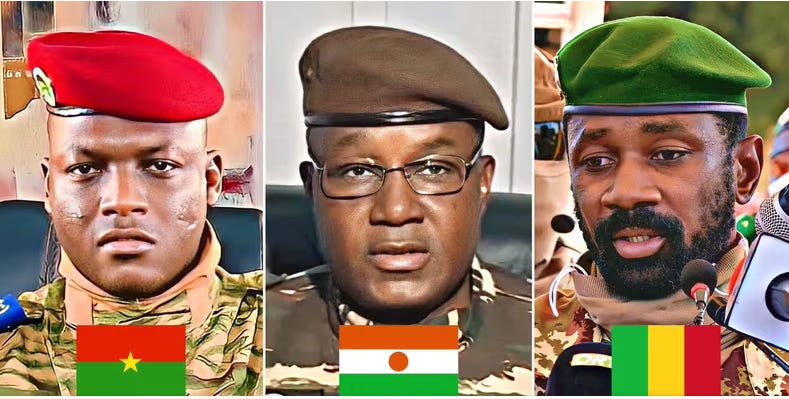
Following successive military coups between 2020 and 2023, Mali, Niger, and Burkina Faso have embarked on a new path: a coordinated rejection of Western neocolonialism, most notably the influence of France and the United States. These countries have formed the Alliance of Sahel States (AES), a mutual defense pact and political realignment shifting West Africa's geopolitical landscape. The actions of the new rulers to dismantle entrenched neocolonial structures are 21st-century decolonization.
The term Françafrique has long described the intricate web of military, financial, and political relationships that kept France entrenched in the affairs of its former African colonies. For decades, Mali, Niger, and Burkina Faso remained tied to Paris through unequal military agreements, the CFA franc monetary system, and preferential contracts for French companies. This dependency extended to critical sectors such as energy—Niger's uranium powers one-third of France's electricity—and security, with French and U.S. troops stationed throughout the Sahel under the guise of counterterrorism (Vo; Al Jazeera).
The new rulers in these countries portray their coups as acts of liberation from external domination. Their argument resonates strongly with populations frustrated by poverty, inequality, and a post-colonial system that enriched foreign powers at the expense of Africa. In this context, forming the Alliance of Sahel States in September 2023, followed by a confederation treaty in July 2024, is a declaration of independence from a rigged international order (Al Jazeera).
One of the signs of this shift is the expulsion of Western military forces. In 2022, Mali terminated its defense agreements with France, accusing it of undermining national sovereignty. Burkina Faso followed suit in early 2023, giving France one month to withdraw its troops. Niger, once considered France's last stronghold in the region, took similar action in late 2023, also expelling U.S. military personnel and ending drone operations at its $100 million base near Agadez (Vo; Al Jazeera).
Popular uprisings have accompanied these actions. Anti-French protests in the capitals of Bamako, Niamey, and Ouagadougou, including the storming of embassies and the burning of French flags, indicate that the rejection of Western influence is rooted in grassroots nationalist sentiment (Vo).
Mali, Niger, and Burkina Faso are not only rejecting military presence; they are actively restructuring economic relationships to prioritize domestic control over natural resources. In Mali, where gold accounts for 90% of exports, the government has implemented a new mining code that increases the state's stake in mining ventures from 20% to 35% and eliminates tax breaks for foreign firms like Canada's Barrick Gold. The seizure of $200 million in gold stockpiles significantly changed how Sahelian governments view their resource sovereignty (RT Staff).
Similarly, Niger has suspended uranium and gold exports to France, directly challenging the neocolonial model where African nations supply raw materials but remain impoverished. The broader objective of ensuring that "gold shines for Malians" aligns with these actions, aiming to ensure that the local population benefits from mineral wealth instead of foreign investors (RT Staff).
The AES states have also withdrawn from regional and international structures perceived as tools of Western control. In 2023, they exited the G5 Sahel security pact and, in early 2024, announced their withdrawal from the Economic Community of West African States (ECOWAS). ECOWAS, long criticized for enforcing neoliberal austerity measures and suppressing nationalist governments, had suspended the three countries after their coups and threatened sanctions. The military leaders responded by denouncing ECOWAS as a puppet of foreign powers and vowing to create "an AES of the peoples" (Al Jazeera).
This shift in dependence on a single dominant power aims for greater strategic flexibility through multipolarity. Historical ties to the Soviet Union and current Russian investments in gold, oil, and security infrastructure reinforce this new alignment (Vo).
The trajectory of Mali, Niger, and Burkina Faso illustrates a post-colonial realignment. These nations are becoming more independent and less reliant on the West.
A cornerstone of French neocolonial influence in West Africa is the continued use of the CFA franc. The French government created the CFA franc in 1945 to maintain its economic dominance over former colonies by linking their currencies to the French franc—and later, the euro. Fourteen African countries, including Mali, Niger, and Burkina Faso, still use the CFA franc today. Critics have long condemned this monetary system for perpetuating economic dependence and limiting the sovereignty of its users.
Under the CFA system, member states must deposit half of their foreign exchange reserves into the French Treasury. France used this arrangement to control the money supply of African nations, earn interest, and weaken their financial power. France still guarantees the CFA franc's convertibility, influencing the region's monetary policy decisions.
This currency arrangement significantly constrains economic development. It pegs local currencies to the euro at a fixed rate, preventing these countries from devaluing their currencies to stimulate exports or manage inflation. The result is a structure that favors imports from Europe and hinders the growth of local industries. Moreover, the CFA franc's overvaluation makes it difficult for Sahelian agricultural and artisanal sectors to compete in global markets, reinforcing the region's status as a supplier of raw materials.
In tandem with monetary control, France has utilized a network of post-independence agreements to entrench its dominance. These agreements often include stipulations such as 'first rights' to all natural resource discoveries, the mandatory use of French military advisors, and contractual preferences for French firms. Many of these agreements remain in effect and function as legal instruments of neocolonialism, ensuring that economic and political power flows back to Paris.
The rulers of Mali, Niger, and Burkina Faso have increasingly linked their rejection of Western influence to a broader critique of this system. They argue that the CFA franc and associated financial structures are relics of colonialism designed to extract wealth and suppress sovereignty. Popular movements in these countries have echoed this sentiment, with protesters demanding the abolition of the CFA franc and the establishment of truly independent monetary institutions.
Critics of the system highlight its role in fostering capital flight. Elites with ties to France can easily transfer wealth abroad, while the public sector remains underfunded. French companies often dominate sectors such as telecommunications, transportation, and energy through no-bid contracts inherited from the colonial era. This economic stranglehold reinforces political dependence and limits the potential for structural reform.
The AES countries are beginning to challenge this system more directly. Leaders have called for the creation of a new currency and suspended or renegotiated contracts with French firms, especially in mining and infrastructure. While these steps are in their early stages, they signal a shift toward economic decolonization that complements the military and political realignments already underway.
Among the AES nations, Burkina Faso has taken significant steps to reject neocolonial control and build national wealth and infrastructure. The country has pursued agriculture, industry, and education reforms to secure a more independent future, recognizing that its political sovereignty must be matched by economic self-reliance.
In 2025, Burkina Faso temporarily banned the export of raw cashew nuts to promote local processing. This measure aims to revitalize the domestic cashew industry, which had struggled to meet its processing capacity due to competition from foreign buyers. Authorities hope this policy will enable factories to operate at full capacity, increase employment, and retain more of the value chain within the country. To support this effort, the government, through the Dumu Ka Fa Fund, introduced credit facilities of up to 500 million CFA francs for processors, signaling a commitment to industrial sovereignty (Food Business Africa).
Beyond agriculture, Burkina Faso has also gained attention with the launch of its first fully indigenous electric vehicle, branded ITAOUA. Designed and manufactured entirely by Burkinabe engineers using local resources, the car demonstrates the country's growing industrial and technological capabilities. With models boasting advanced features like solar charging and a 330-kilometer range on a 30-minute charge, the ITAOUA car represents a significant step toward reducing dependency on imported fossil-fuel vehicles while creating jobs in clean energy and transportation (Electricity Hub).
The education sector has also undergone transformative reforms. Burkina Faso eliminated all primary and university school fees, ensuring free public education for all citizens. This initiative aims to address long-standing inequalities in access to education and empower youth with the knowledge and skills needed to drive national development. The policy investments in human capital and social infrastructure, even as the government faces challenges in securing long-term funding and infrastructure.
These efforts reflect a comprehensive vision of development that extends beyond simply rejecting foreign military presence or economic contracts. Burkina Faso attempts to lay the foundations of a post-colonial model rooted in sovereignty, industrial policy, social equity, and innovation. While the path ahead remains challenging, the initiatives taken under the current leadership suggest a serious commitment to reshaping the country's place in the global economy.
The AES states are directly confronting the legacy of neocolonialism. Their efforts to sever ties with France and the West—whether through expelling troops, reclaiming resources, or withdrawing from ECOWAS—represent a break from the post-colonial status quo. They demand freedom from colonial influence and the autonomy to determine their futures.
Works Cited
Al Jazeera. "Niger, Mali and Burkina Faso Military Leaders Sign New Pact, Rebuff ECOWAS." Al Jazeera, 6 July 2024.
RT Staff Reporters. "Sahel's Gold Rush: Rulers Seize Control Amid Foreign Tensions." 16 Jan. 2025.
Vo, Sunny. "Junta Rule in the Sahel: Decolonization and Destabilization." Harvard International Review, 25 Jan. 2025.
Electricity Hub. "Burkina Faso Unveils First Indigenous Electric Vehicle." The Electricity Hub, 6 May 2025.
Food Business Africa. "Burkina Faso Suspends Raw Cashew Exports to Support Local Processing." 4 Apr. 2025.
Untitled Document. "Burkina Faso Eliminates School Fees from Primary to University." 2025.